
Perfect for beginner gardeners and beyond, the USDA Plant Hardiness Zone Map gives you the information you need to set up your garden for success from the start. The map helps you identify your USDA Plant Hardiness Zone by ZIP code, allowing you to choose plants that are well-suited to your local climate.
Read on to learn more about plant hardiness zones and how to use the USDA Plant Hardiness Zone Map effectively. Happy gardening from your friends at Swan!
What Is a Plant Hardiness Zone?
A plant hardiness zone (or planting zone) is a geographic area defined by its average annual extreme minimum winter temperature, an important factor in determining which plants are most likely to survive and thrive in a particular location.
Plant hardiness zones were developed by the United States Department of Agriculture (USDA) to help gardeners, growers, and landscapers select plants that can withstand the coldest temperatures typically experienced in their region. Today, the USDA Plant Hardiness Zone Map remains the most widely used planting zone system in the United States.
The 13 USDA Plant Hardiness Zones
The USDA has divided the country, including Alaska, Hawaii, and Puerto Rico, into 13 plant hardiness zones. For example, Zone 1 includes some of the coldest regions of Alaska, including areas near Fairbanks; Zone 11 includes most of Hawaii; and Zones 12 and 13 are in Puerto Rico. Each of the 13 zones is then divided into two number/letter-combination growing zones for greater accuracy, as follows:
Zone 1a Zone 1b Zone 2a Zone 2b Zone 3a Zone 3b
Zone 4a Zone 4b Zone 5a Zone 5b Zone 6a Zone 6b
Zone 7a Zone 7b Zone 8a Zone 8b Zone 9a Zone 9b
Zone 10a Zone 10b Zone 11a Zone 11b Zone 12a Zone 12b
Zone 13a Zone 13b
Plant Hardiness Zones’ Average Minimum Temperatures
As illustrated in the chart below, each of these 13 plant hardiness zones has an average annual extreme minimum temperature range of 10 degrees. For example, Zone 1 (1a and 1b) has a combined average annual extreme minimum temperature range of -60° F to -50° F, while the range for Zone 13 (13a and 13b) is 60° F to 70° F.
Each planting zone is generally 10 degrees warmer (or colder) during an average winter than the adjacent zone, with higher zone numbers representing warmer climates.
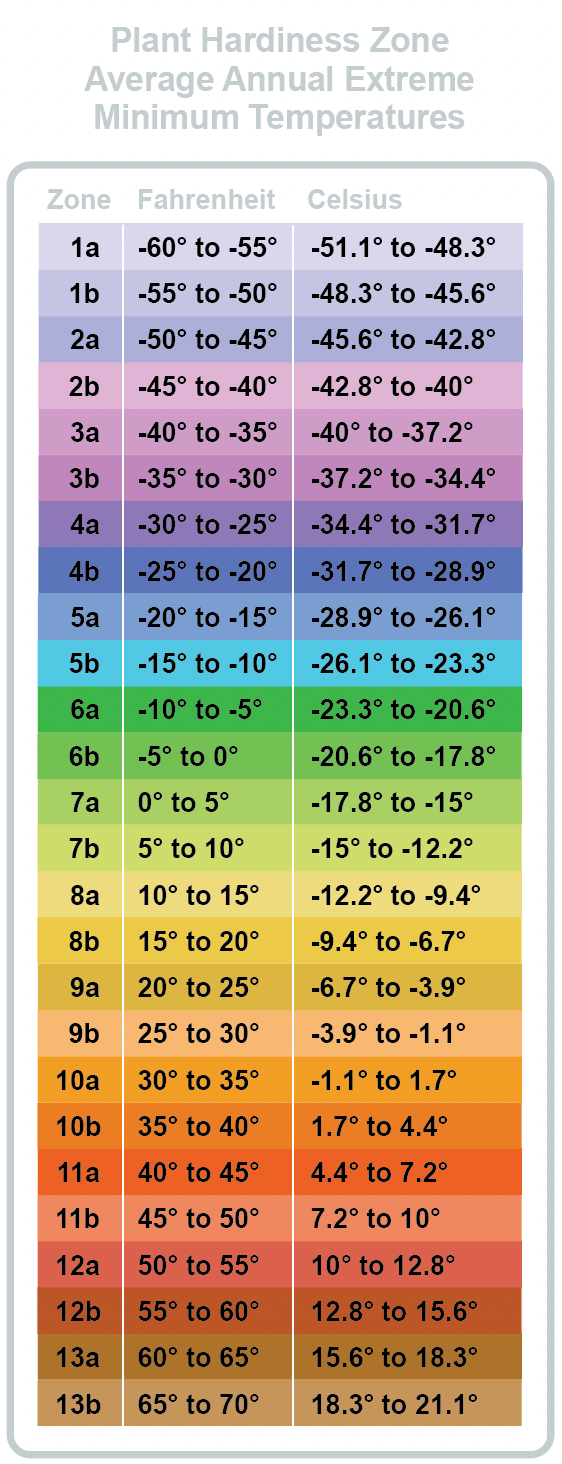
To understand this chart more fully in relation to gardening, if a plant is hardy to Zone 5, for instance, and your garden is in Zone 6, that plant should survive the coldest temperatures typically experienced in your area. However, if you live in Zones 1, 2, 3, or 4, your average annual extreme minimum temperature will generally be too cold for a Zone 5 plant to survive outdoors year after year.
Most seeds and plants today come with a label listing their recommended plant hardiness zone, so be sure to look for it.
How to Find Your Plant Hardiness Zone
Click the USDA Plant Hardiness Zone Map to visit the USDA website. Once there, enter your ZIP code into the search box or browse the interactive map to find your location.
The map will display your planting zone along with the average annual extreme minimum temperature for your area. You can also use the map legend to explore the various planting zones and their corresponding colors.
Knowing your plant hardiness zone can help you make informed decisions when selecting trees, shrubs, perennials, and other plants for your landscape.
We hope you find the USDA Plant Hardiness Zone Map a helpful resource as you begin or continue your gardening journey. Also, be sure to check out the Articles section on our website for expert information on topics such as gardening, hoses and watering, as well as all the latest Swan news.


